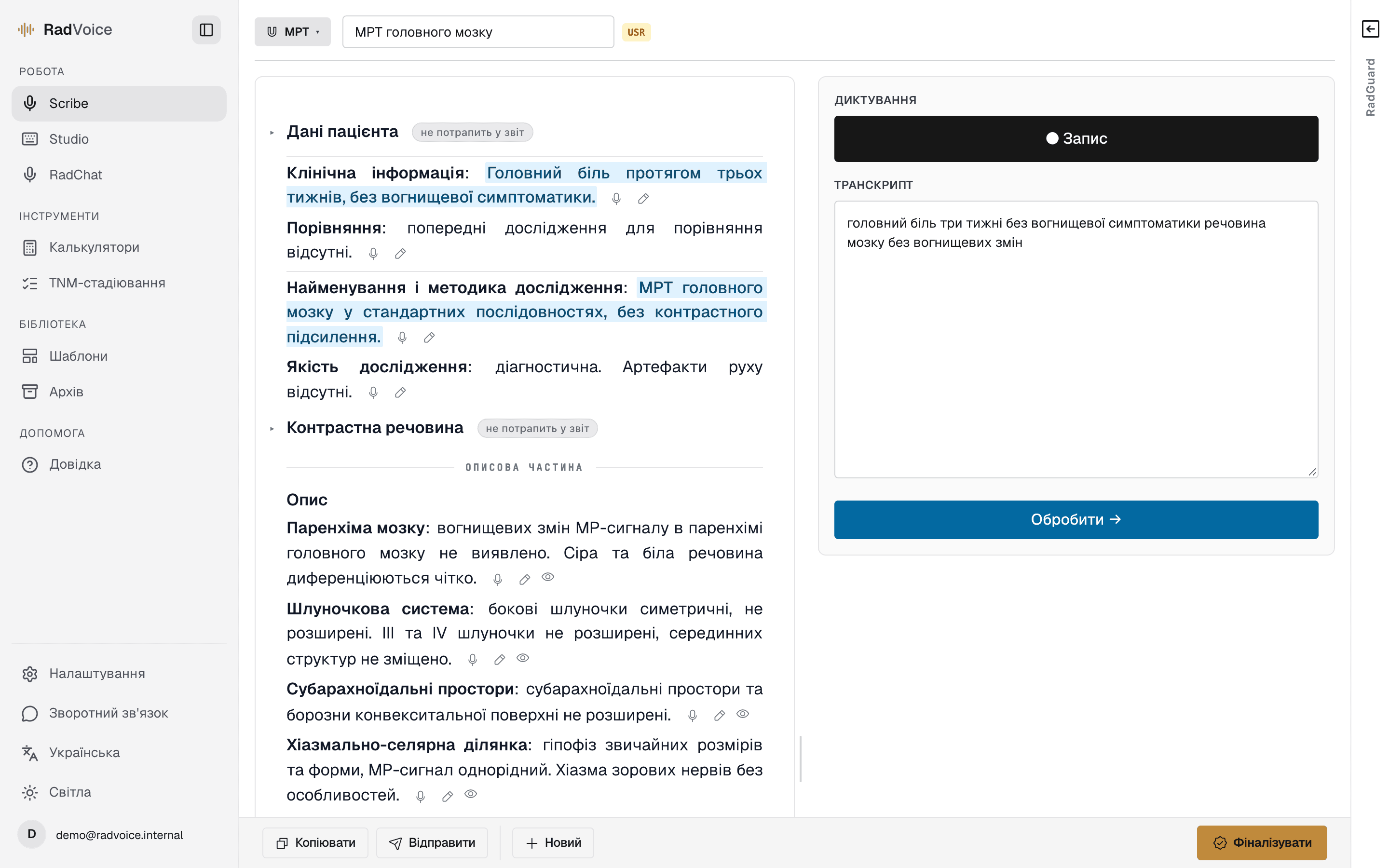
Scribe
Say it all, the model sorts it.One stream of speech for the whole study. Fastest to start and the most comfortable on a phone.
Routine studies, working from a phone
RadVoice listens to your dictation, sorts it into the sections of your template and hands you a draft to review and sign. In English and Ukrainian.
Updates live as radiologists dictate.
PI-RADS, LI-RADS, BI-RADS, TNM and the other systems you already use.
From plain film to PET-CT; templates are picked by modality and region.
English and Ukrainian, switchable at any time.
Your workflow stays the same: you look at the study and speak. What changes is that there is no keyboard between the dictation and the signature.
The way you always have: free text, all at once or section by section. From a laptop or a phone, with any microphone or a SpeechMike.
The transcript is cleaned of filler and distributed across the sections of your template. Numbers, laterality and units are preserved.
Unmapped fragments are highlighted and every section is linked to its place in the transcript. You edit, click Finalize and paste into your RIS.
Both end in the same structured report. The difference is how much control you want to keep in your hands while dictating.
One stream of speech for the whole study. Fastest to start and the most comfortable on a phone.
Routine studies, working from a phone
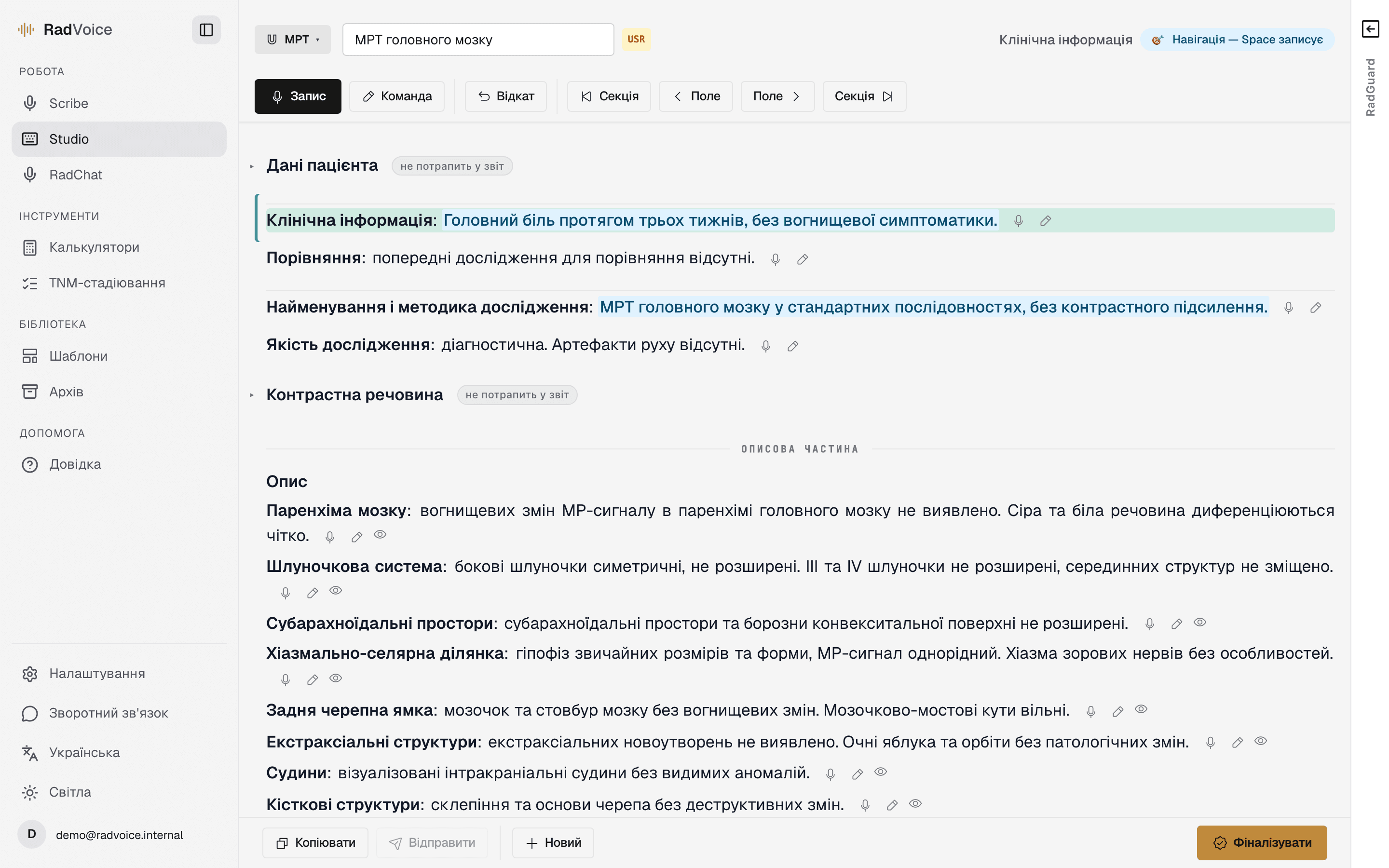
Move between template fields with keys or SpeechMike buttons and dictate each one separately.
Complex protocols, PowerScribe habits
A library of 200+ system templates across 9 modalities. Copy any of them and make it yours: change sections, add repeatable blocks, attach a classification.
Plus CAD-RADS, Bosniak, 17 TNM systems, volume and ratio calculators.
Speech recognition makes mistakes and so do language models. Every step is built so that an error is visible before the signature, not after.
A fragment of dictation that did not land in any section does not vanish; it waits for your decision.
Hover over any sentence of the report to see exactly which of your words it came from.
Before finalizing, the report is checked for conflicts between findings and impression, for left/right, for missed checklist items.
Every check only warns. The decision always stays with the physician.
RadVoice is not a medical device and does not make diagnoses. It is a documentation tool: the physician who signs the report is responsible for its content.
Interface, templates and speech recognition work in both languages. Dictate in Ukrainian and produce an English report for a clinic abroad, or the other way round. The language switches in one click and is saved to your profile.
The free plan is enough to find out whether this is for you. Pro is for daily work.
Free
$0forever
Pro
$29per month
$290 a year, two months free
Billed in UAH via monobank; the dollar price is indicative. No card on Free. Cancel any time; full refund within the first 14 days after payment. Full plan details
Signing up takes a minute and needs no card. If anything is off, write to me directly: I read every message.
Try it free